
LAFVIN Basic Starter Kit
4.5Editor score
Includes essential sensors
Arduino IDE compatible
Beginner friendly tutorials
This guide compares the best ESP32 Starter Kit options for beginners and experts, evaluating sensors, tutorials, and features to help you choose.
Embarking on your journey into the Internet of Things requires a reliable foundation. An ESP32 Starter Kit provides the essential hardware and resources needed to build connected devices. These kits simplify the learning curve by bundling microcontrollers with sensors and modules.
We evaluated top kits based on component quality, tutorial depth, and ease of use. Our analysis focuses on value, compatibility with popular IDEs, and the range of projects you can build. We prioritized kits that support both beginners and those seeking advanced capabilities.
Each selection below highlights unique strengths, from budget-friendly options to premium boards with camera features. These picks showcase what makes each kit stand out for learning and prototyping. Note that availability and pricing may change, so always check current listings before purchasing.
4.5Editor score

4.3Editor score

4.6Editor score
The following table provides a side-by-side comparison of all ten kits to help you quickly identify the right fit for your needs.


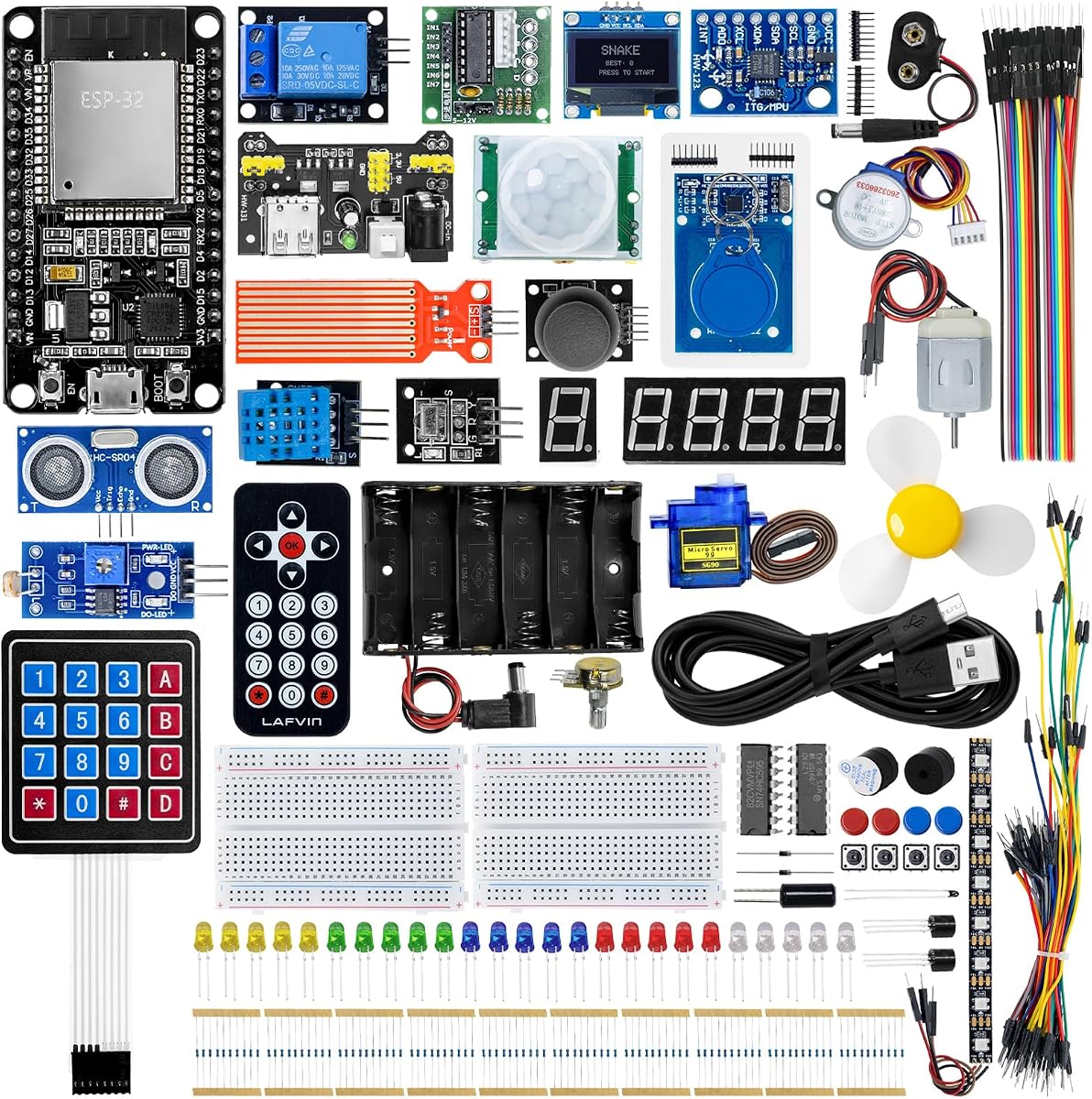


This kit stands out for its comprehensive collection of components and clear tutorials. It is rated well by users who appreciate the depth of learning materials. The focus on IoT capabilities makes it suitable for modern smart home projects.
We may earn a commission when you buy through this link, at no additional cost to you.
The ESP-32 board offers dual-core processing and integrated wireless connectivity. You get over 35 modules including sensors, displays, and motors. The step-by-step online tutorial guides you through 30+ projects with clear circuit diagrams and code examples.
While it lacks a camera module compared to some premium kits, it covers essential electronics thoroughly. The price reflects the quality of components and the extensive guide. This trade-off is acceptable for learners prioritizing broad electronic fundamentals.
Ideal for students, makers, and engineers seeking a robust foundation in IoT. It supports progression from basic circuits to advanced applications. We recommend this for those who want a reliable path to building smart devices.
The kit includes diverse modules like OLED screens, servo motors, and keypads to ensure versatile project possibilities.
Beginner-friendly tutorials with refined code help you understand electronics and coding principles systematically.
We may earn a commission when you buy through this link, at no additional cost to you.
This is an excellent choice for those on a tight budget who want to start learning electronics. It is rated highly for simplicity and ease of use by beginners. The kit focuses on core functionalities without overwhelming complexity.
We may earn a commission when you buy through this link, at no additional cost to you.
It includes an ESP32 module capable of controlling basic devices like LEDs and sensors. The tutorial provides codes and lessons to teach assembly and programming at an introductory level. You can download the tutorial to learn after receiving the goods.
The limited component count means fewer project variations compared to more expensive kits. However, for the price, it delivers solid value for foundational skills. This is acceptable for users who need a simple starting point.
Perfect for absolute beginners wanting to test their interest in IoT without a large investment. It helps you gain practical experience with microcontrollers and wireless communication. We recommend this for educational settings or casual hobbyists.
The low price point removes financial barriers for students and hobbyists new to embedded systems.
Easy-to-follow tutorials ensure you can start programming without needing prior experience or technical knowledge.
We may earn a commission when you buy through this link, at no additional cost to you.
This ultimate kit offers advanced features like a camera board and significant memory. It is rated highly for its comprehensive approach to teaching electronics and coding. The inclusion of camera capabilities opens up unique project opportunities.
We may earn a commission when you buy through this link, at no additional cost to you.
The board features a dual-core processor with ample flash and PSRAM for complex tasks. You get access to 122 projects ranging from simple to complex with detailed schematics and code. The tutorial is extensive at 795 pages and supports multiple languages.
The complexity and higher price might be a barrier for casual beginners seeking simple circuits. However, for serious learners, the value of the included memory card and camera is high. This trade-off is worth it for those targeting professional-grade projects.
Ideal for engineers and students who need a powerful platform for computer vision or advanced IoT. It supports MicroPython, C, and Processing for diverse application development. We recommend this for users ready to tackle complex engineering challenges.
The onboard camera allows you to build security systems or motion detection tools right out of the box.
Support for Python and C ensures you can choose the language that best fits your specific project needs.
We may earn a commission when you buy through this link, at no additional cost to you.
This kit upgrades to the newer ESP32-S3 board with improved memory and connectivity. It is rated highly for performance and modern feature support in development projects. The board supports faster processing and secure boot capabilities.
We may earn a commission when you buy through this link, at no additional cost to you.
You get an 8 MB flash and 8 MB PSRAM for handling larger code bases and assets. The kit includes a camera and memory card slot for image processing tasks. Tutorials guide you through 121 projects with complete code and wiring diagrams.
The higher price reflects the premium components and the latest chip technology. Availability might be tighter than standard kits due to demand for the S3 chip. This is acceptable for users who need the most up-to-date hardware standards.
Perfect for developers building next-generation IoT devices or robotics applications. The Bluetooth 5 LE support is ideal for long-range and low-power communications. We recommend this for advanced users seeking cutting-edge performance.
Bluetooth 5 LE provides better range and lower power consumption for wireless sensor networks.
The USB-OTG and secure boot features prepare your projects for modern security and peripheral needs.
We may earn a commission when you buy through this link, at no additional cost to you.
This kit is designed specifically for education and beginner hands-on learning. It has a perfect 5.0 rating from users who value its educational focus. It combines the ESP32-S board with essential modules for practical experiments.
We may earn a commission when you buy through this link, at no additional cost to you.
The development board supports wireless communication and sensor-based projects easily. Components allow you to test inputs and outputs without complex setup. It is compatible with the Arduino IDE for a familiar programming environment.
It lacks advanced features like camera or complex sensor arrays found in premium kits. The focus remains on foundational skills which limits complexity. This is acceptable for classrooms or users prioritizing simplicity over high-end specs.
Ideal for STEM education, classroom activities, and home DIY projects. It helps beginners develop skills in coding and circuit building effectively. We recommend this for schools or parents looking for a reliable educational tool.
The kit is structured to support educational curricula with clear steps and basic components for students.
Hands-on experiments encourage understanding of real-world sensor and microcontroller interactions.
We may earn a commission when you buy through this link, at no additional cost to you.
This basic version includes a camera board for visual projects at a lower cost than the Ultimate kit. It is rated highly for balancing features with affordability. The board supports dual-core processing and wireless connectivity.
We may earn a commission when you buy through this link, at no additional cost to you.
You get 58 projects designed to take you from simple to complex. The tutorial includes schematics and wiring diagrams for easy assembly. It supports MicroPython and C for flexible coding options.
It has fewer items and slightly less memory than the Ultimate version. However, it still covers essential camera functionality well. This trade-off is acceptable for those wanting visual capabilities without the full Ultimate price.
Ideal for hobbyists wanting to explore computer vision without a huge investment. It is a practical step up from standard electronics kits. We recommend this for users interested in camera-based IoT projects.
The included camera allows for basic video streaming and motion detection experiments.
You get key advanced features without paying for unnecessary components you might not use.
We may earn a commission when you buy through this link, at no additional cost to you.
This kit focuses heavily on real-world IoT applications and web-based control. It is rated well for users interested in smart home prototypes. The tutorials emphasize using Wi-Fi capabilities fully for remote control.
We may earn a commission when you buy through this link, at no additional cost to you.
It includes sensors like ultrasonic, RFID, and PIR for various detection tasks. You can build web interfaces to control devices via a browser. Projects cover diverse areas from environmental monitoring to motion detection.
The focus on IoT might make basic electronics learning feel slower than other kits. However, for users specifically wanting networked devices, it is efficient. This is acceptable for those targeting immediate smart home integration.
Perfect for makers who want to build connected home automation systems quickly. It provides the hardware needed for secure sensor data monitoring. We recommend this for users interested in web-connected IoT.
Build interfaces you can access from any smartphone to control your devices remotely.
The range of modules like servo motors and RFID readers supports varied automation projects.
We may earn a commission when you buy through this link, at no additional cost to you.
This kit is designed for quick prototyping with a half-size breadboard included. It has a 5.0 rating for ease of immediate use. It includes an expansion board and essential sensors for standard tasks.
We may earn a commission when you buy through this link, at no additional cost to you.
The 38-pin development board offers standard connectivity options. You get popular sensors like HC-SR04 ultrasonic and DS18B20 temperature. Online tutorials support both Arduino IDE and MicroPython for flexibility.
It lacks the extensive project count of larger kits but covers basics well. The breadboard saves you from buying one separately. This trade-off is acceptable for those who want to prototype immediately.
Ideal for makers who already have basic knowledge and want to jump into building. It provides the essential tools for rapid circuit testing. We recommend this for users focused on speed and simplicity.
The inclusion of a breadboard means you can start wiring circuits without extra purchases.
Common sensors and displays ensure compatibility with existing project designs and code.
We may earn a commission when you buy through this link, at no additional cost to you.
This kit supports three programming methods including Scratch for beginners. It is rated well for educational structure and organization. It includes 40+ tutorials designed to guide you from circuits to IoT.
We may earn a commission when you buy through this link, at no additional cost to you.
The components are individually labeled and packaged to prevent confusion. You get sensors, breadboards, and LEDs to build practical projects. The kit supports Arduino IDE, Scratch, and Python for flexible learning.
The focus on organization and structured lessons means fewer raw components than some competitors. This is acceptable for learners who benefit from clear pathways and labeling. It reduces frustration for younger users.
Ideal for STEM clubs and teens starting their coding journey. The drag-and-drop support makes the transition to coding smoother. We recommend this for education-focused buyers who value organization.
Start with Scratch and move to Python or C as you grow your skills without changing kits.
Every component is labeled to reduce assembly errors during complex circuit building.
We may earn a commission when you buy through this link, at no additional cost to you.
This kit uses a unique modular design with standardized cables for sensors. It is rated well for quick setup without breadboard wiring. The ESP32-S3 board supports native USB and secure boot.
We may earn a commission when you buy through this link, at no additional cost to you.
It includes 12 sensors like microphone and RGB LED bar. Each sensor connects to dedicated ports on the expansion board. This allows for rapid prototyping without complex wiring or loose connections.
The modular approach means you pay for convenience and specialized design. Limited variety compared to bulk kits is the trade-off. This is acceptable for those who value clean connections and quick setup.
Perfect for robotics and IoT applications requiring clean signal handling. The standardized connectors simplify long-term project maintenance. We recommend this for developers who prioritize modularity and speed.
Standardized cables reduce noise and connection errors compared to jumper wire setups.
Plug-and-play ports allow you to swap sensors instantly for testing different inputs.
We may earn a commission when you buy through this link, at no additional cost to you.
Choosing the right ESP32 starter kit depends on your goals, budget, and desired learning path. This section outlines key factors to consider before purchasing to ensure you get the best value and learning experience.
The first factor to consider is the variety of modules included in the kit. Look for kits that offer a range of sensors, displays, and motors to build diverse projects. High-quality components ensure reliability and reduce frustration during wiring and testing.
Choose kits with clear labeling and organized packaging to simplify assembly.
A good kit should include detailed tutorials with circuit diagrams and code examples. Check if the guide is available online or in print and if it supports your preferred programming language. Comprehensive tutorials help you understand the why behind the code.
Prioritize kits with step-by-step guides that progress from simple circuits to complex IoT applications.
Evaluate the ESP32 board's processor speed, flash memory, and connectivity options. Newer models like the ESP32-S3 offer more flash and better Bluetooth capabilities. If you need camera functionality, ensure the kit includes a board with a camera module.
Select a board that matches your performance needs for future projects.
Consider which programming languages are supported by the kit's tutorials. Most kits support Arduino IDE, but some also offer MicroPython or Scratch for beginners. Ensure the environment aligns with your current skills or educational goals.
Choose kits that support the languages you are most comfortable with.
The number and complexity of included project examples indicate the kit's versatility. Look for kits that offer projects ranging from blinking LEDs to web servers or smart sensors. A wide variety of projects keeps learning engaging and challenging.
Select a kit that offers projects matching your specific interests like robotics or home automation.
Compare the price against the number of components and the quality of documentation. While cheaper kits may save money, they often lack essential tools like breadboards or detailed guides. Value is defined by how much you can learn without buying extra parts.
Choose a kit that fits your budget but includes the essentials for a complete experience.
A strong online community and manufacturer support can be invaluable when troubleshooting. Look for brands with active forums and responsive technical teams. Community support often provides additional project ideas and solutions beyond the included tutorial.
Prioritize brands known for their active user communities and reliable support channels.
Consider how easy it is to expand the kit with additional components later. Kits that use standard connections and common pinouts make it easier to integrate new sensors. Expandability ensures the kit remains useful as your skills grow.
Choose a kit that uses standard connectors to allow for future hardware additions.
To use your kit, start by reviewing the tutorial guide and identifying components. Connect the ESP32 board to your computer via USB and install the required drivers. Use the Arduino IDE or other supported environments to upload test code and verify functionality.
Store your components in a dry and cool environment to prevent damage from humidity or heat. Use anti-static bags for sensitive modules to avoid electrostatic discharge. Organize parts in labeled containers to make future projects easier to assemble.
When handling modules, avoid bending pins excessively or applying excessive force. Regularly check connections to ensure wires are secure and not frayed. If the board stops responding, try resetting it by pressing the reset button or power cycling.
The ESP32 offers built-in Wi-Fi and Bluetooth, along with dual-core processing, which makes it superior for IoT projects. It also has more memory and analog inputs compared to the Uno. However, the Uno is simpler for basic logic tasks and might be easier for absolute beginners.
Many kits include a breadboard, but if not, it is highly recommended for prototyping. It allows you to connect components without soldering. If your kit lacks one, ensure you purchase a half or full-size breadboard separately for best results.
While you can run pre-written code from tutorials, understanding basic coding is necessary for customization. Some kits support graphical coding like Scratch to make the entry easier. Coding is essential for modifying projects to fit your specific needs.
C++ via Arduino IDE is the most common and has the largest library support. MicroPython is also popular for its simplicity and rapid development. The best choice depends on your familiarity with syntax and project complexity.
Connect sensors using the GPIO pins, matching power, ground, and signal lines correctly. Refer to the pinout diagram provided in the tutorial to avoid short circuits. Use jumper wires to link the sensor modules to the board.
Most starter kits are designed to be used without soldering, using jumper wires and breadboards. If you wish to make permanent connections, you may need a soldering iron. Check the kit contents to see if components are pre-soldered.
Yes, you can power the ESP32 using batteries or power banks via the USB or VIN pins. Ensure the voltage is within the supported range, typically 3.3V to 12V. Use a voltage regulator if your battery output exceeds the board limits.
You can build weather stations, smart home controllers, and remote monitoring systems. The kit supports projects like smart lighting, motion detectors, and web-controlled motors. The possibilities are limited only by your imagination and component availability.
We highlighted the ELEGOO Super Starter Kit as the top pick for its comprehensive components and detailed tutorials. The LAFVIN Basic Kit offers excellent value for those on a strict budget, while the Freenove ESP32-S3 provides premium features for advanced users.
Prioritize the kit that offers the best balance of components and learning resources for your specific goals. If you are interested in IoT, choose a kit with strong Wi-Fi and cloud support. For robotics, look for motor drivers and sensors.
Prices and stock levels change frequently so verify current listings before finalizing your purchase. Check the product page for updates to tutorials or included accessories. Buying from a reputable seller ensures you get the latest version and reliable support.