
ESP8266 ESP-01S
4.4Editor score
4MB Flash Memory storage
Stronger signal version
Compatible with Arduino IDE
This guide compares the top Arduino WiFi Module options for 2026, reviewing features, performance, and compatibility to help you choose the right wireless
Connecting microcontrollers to the internet has become essential for modern IoT projects. Arduino WiFi modules enable seamless communication between sensors, devices, and cloud platforms. Whether you are building smart home systems or industrial monitors, selecting the right module ensures stability and ease of use.
We evaluated ten leading options based on connectivity features, processing power, and developer support. Each product was analyzed for its wireless range, protocol support, and integration with the Arduino IDE. Our goal is to help you find a module that fits your specific technical requirements and budget constraints.
Each pick below highlights key strengths and ideal use cases for developers. We focus on real-world performance, ease of programming, and long-term reliability. Please note that prices and availability may change over time, so check the current listings before making your final purchase decision.
4.4Editor score

4.7Editor score

4.7Editor score
The following table provides a side-by-side comparison of all ten selected Arduino WiFi modules. We highlight essential specifications to help you quickly identify the right fit for your project requirements.



This board stands out as a complete development solution with integrated wireless capabilities. It holds a 4.7 rating and is designed for advanced IoT needs. The combination of a Renesas controller and an ESP32-S3 chip offers exceptional versatility for complex tasks.
We may earn a commission when you buy through this link, at no additional cost to you.
The dual-core processing enables simultaneous tasks like data logging and wireless transmission without lag. Integrated features like the 12-bit DAC and Qwiic connector simplify circuit design for audio and sensor projects. The USB-C port ensures reliable power and data transfer during development.
While the price is higher than simple add-on modules, the all-in-one design reduces the need for extra breakout boards. The learning curve for the new features is manageable with community support. This makes it a solid long-term investment for serious makers.
Advanced users and professionals should choose this for projects requiring robust communication and processing. It is ideal for industrial prototypes where reliability matters. For beginners, it offers room to grow as skills develop.
Wi-Fi and Bluetooth 5.0 ensure stable connections for remote control and sensor networks without extra hardware.
The 12-bit DAC and OP AMP provide high-fidelity signal output for audio or precision control applications.
We may earn a commission when you buy through this link, at no additional cost to you.
This pack offers three standard ESP8266 modules ideal for testing multiple prototypes. It has a 4.2 rating and is widely used for simple wireless tasks. The ESP8266 chip provides reliable processing and storage for basic IoT applications.
We may earn a commission when you buy through this link, at no additional cost to you.
Supporting AP STA and AP+STA modes gives flexibility for connecting to networks or acting as a hotspot. The built-in processing capabilities reduce the need for external components. Developers can use LWIP stacks for efficient TCP IP implementation in their sketches.
The main trade-off is the voltage sensitivity, often needing a 3.3V supply or level shifter. This adds a small step to the wiring process. However, the low cost makes it easy to replace if damaged during experimentation.
Hobbyists needing multiple units for a class or project lab will find this value. It suits simple sensor networks where high speed is not critical. The ease of integration with existing Arduino code makes it a practical choice.
Users can switch between station and access point modes to fit various networking scenarios easily.
We may earn a commission when you buy through this link, at no additional cost to you.
This module is a top choice for those needing extra flash storage at a low cost. It holds a 4.4 rating and is known for its updated signal strength. The 4MB flash allows for more complex code and web server hosting.
We may earn a commission when you buy through this link, at no additional cost to you.
The latest version offers stronger connectivity compared to older ESP-01 models. Developers should select the Generic ESP8266 Module board in the IDE to ensure proper settings. Its small size fits well into tight enclosures for wearable or portable devices.
While it lacks a built-in USB interface, its serial communication is straightforward with a FTDI adapter. Users must ensure their power supply is clean to avoid crashes. These limitations are minor considering the performance it delivers for the price.
Beginners and students often buy this for foundational wireless learning. It works well for home automation sensors or data loggers. The balance of features and cost makes it the best budget option available.
The 4MB flash allows for storing larger libraries and file systems than standard microcontrollers.
We may earn a commission when you buy through this link, at no additional cost to you.
This bulk pack provides five units for classrooms or multiple projects. It has a 4.4 rating and is designed for standard serial WiFi tasks. The modules use 3.0 to 3.6V DC which matches many logic levels with care.
We may earn a commission when you buy through this link, at no additional cost to you.
Supporting AT commands allows direct serial communication for quick tests without full code uploads. Users can integrate these into NodeMCU environments easily. The compact shape helps in space-constrained builds like drones or robots.
The 1MB flash is sufficient for basic sketches but limits complex web server features. Extra care is needed with voltage as they do not tolerate 5V directly. However, the low cost per unit makes this a practical choice for prototyping.
Educators and large project teams should choose this for distribution. It suits simple remote control applications where storage needs are low. The quantity ensures you have spares if one is damaged during soldering.
Direct AT commands allow for rapid connectivity testing without writing full Arduino sketches.
We may earn a commission when you buy through this link, at no additional cost to you.
This set of ESP32 boards offers premium performance with dual-core processing power. It holds a 4.7 rating and is built for responsive IoT tasks. The USB-C interface simplifies power and upload connections compared to older micro-USB standards.
We may earn a commission when you buy through this link, at no additional cost to you.
The dual-core design allows running sensor tasks and wireless communication simultaneously without blocking. Over-the-Air updates let you patch firmware remotely after deployment. This is critical for maintaining connected devices in hard-to-reach locations.
Battery life may require optimization due to higher processing power. However, power saving modes are available to reduce drain. The combination of Bluetooth and Wi-Fi in one module reduces the need for extra components.
Advanced developers should select this for complex home automation or sensor hubs. The speed supports machine learning tasks at the edge. The pack of three ensures redundancy for larger multi-device systems.
OTA support allows firmware upgrades over Wi-Fi without physical access to the board.
We may earn a commission when you buy through this link, at no additional cost to you.
This board is designed for those who prefer Python or need custom input devices. It has a 4.5 rating and includes HID support for creating keyboards or mice. The MicroPython compatibility opens up rapid prototyping options.
We may earn a commission when you buy through this link, at no additional cost to you.
Powered by the ESP32-S3 it offers excellent processing power for real-time tasks. The USB-C port ensures reliable connectivity for debugging and uploads. Developers can create complex interfaces like game controllers or custom peripherals easily.
The main drawback is that headers must be soldered separately for permanent projects. This adds a step to setup but allows for flexible mounting. The new features require checking specific documentation compared to classic Nano boards.
Python developers and those needing input peripherals should choose this model. It fits well in wearable projects or custom UIs. The performance and modern features make it a forward-looking choice for embedded systems.
HID profiles allow the board to act as a keyboard or mouse for computers without extra software.
We may earn a commission when you buy through this link, at no additional cost to you.
This four-pack offers consistent quality for building sensor networks. It holds a 4.4 rating and focuses on reliable RF performance. The modules are designed to be reused multiple times which is great for iterative projects.
We may earn a commission when you buy through this link, at no additional cost to you.
Self-calibrated RF ensures optimal signal strength across different environments. This stability is key for wearable electronics or location sensing devices. The compact design fits easily into small enclosures for distributed sensors.
Programming requires a separate serial adapter which adds to the initial setup. However, this is standard for this form factor. The quality of materials ensures durability during testing and prototyping phases.
Groups building multiple nodes should select this for consistent performance. It works well for home automation lighting or climate monitoring. The reusability helps save costs over time.
Self-calibrated RF ensures consistent signal transmission for reliable data transfer.
We may earn a commission when you buy through this link, at no additional cost to you.
This set provides five modules with generous 4MB flash memory. It has a 4.5 rating and supports the DOUT SPI protocol for programming. The standard baud rate simplifies serial communication configuration.
We may earn a commission when you buy through this link, at no additional cost to you.
Developers must ensure they select the correct SPI MODE as DOUT when flashing sketches. This detail is crucial for avoiding upload errors. The 4MB memory allows for storing more assets like web pages for servers.
Care must be taken with 3.3V voltage as 5V can damage the chip. This is common for ESP8266 variants. The inclusion of five units ensures you have enough for a complete system rollout.
System integrators needing multiple nodes with web server capability should choose this. It suits data logging projects requiring more internal storage. The balance of features in a multi-pack offers strong value.
Proper SPI DOUT mode selection ensures successful firmware uploads and stable operation.
We may earn a commission when you buy through this link, at no additional cost to you.
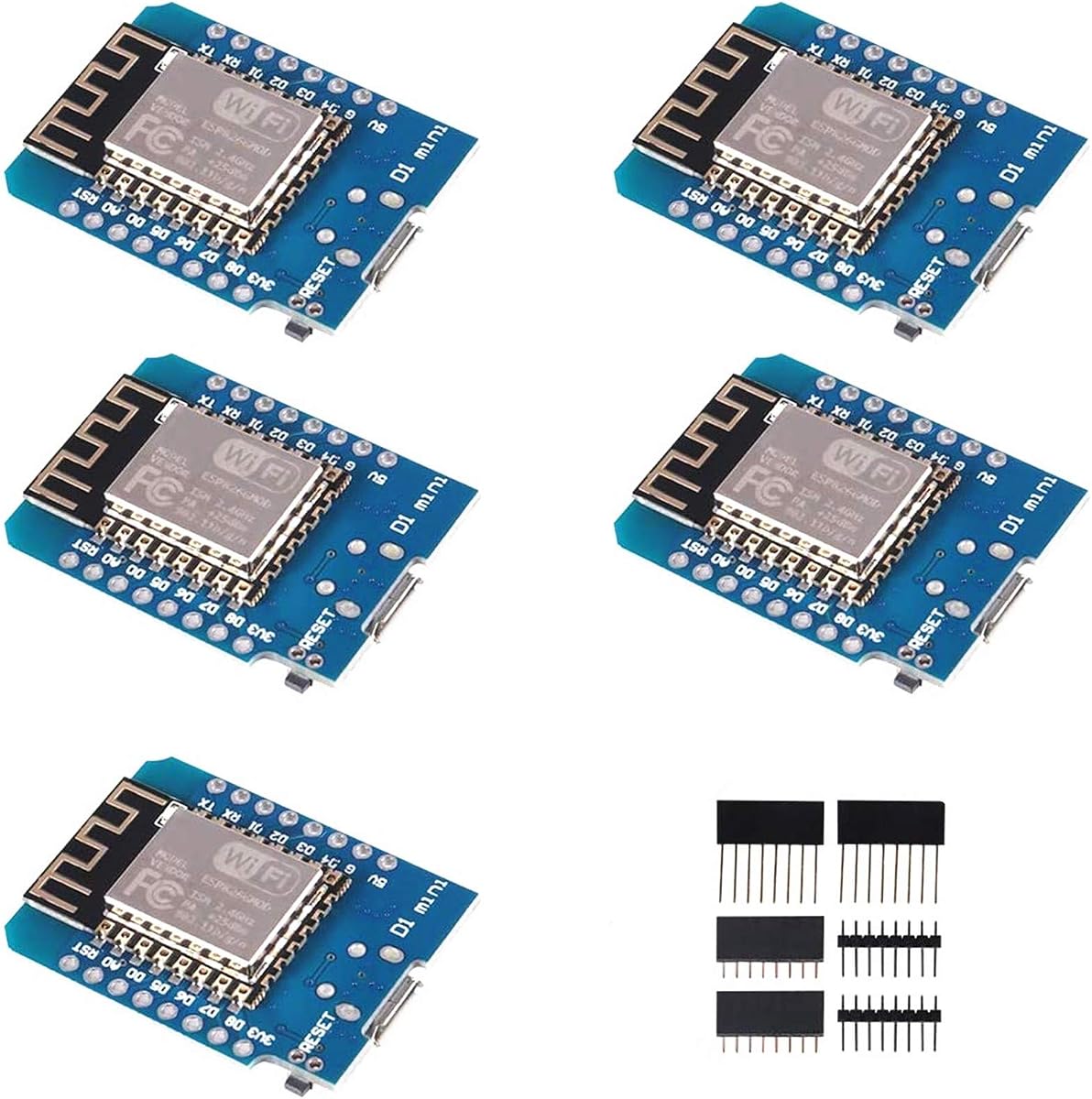
These modules bring more pins and USB connectivity for easy prototyping. They hold a 4.5 rating and include a power supply on board. The 11 digital pins allow for extensive sensor and display connections.
We may earn a commission when you buy through this link, at no additional cost to you.
The Micro USB connection makes uploading code straightforward without adapters. Built-in voltage regulation supports 5V input safely. The support for PWM and I2C protocols enables complex peripheral integration easily.
Analog input is limited to 3.2V so external dividers are needed for higher voltages. The compact board design may require careful handling of solder pads. These are minor issues compared to the connectivity benefits.
Students needing direct USB access and many GPIO pins should choose this. It is excellent for classroom kits or beginner projects. The included power supply simplifies the setup process significantly.
11 digital pins provide ample room for connecting multiple sensors and outputs simultaneously.
We may earn a commission when you buy through this link, at no additional cost to you.
This set offers a large quantity for extensive deployment needs. It holds a 5.0 rating indicating high satisfaction among buyers. The modules support all three WiFi modes for versatile networking options.
We may earn a commission when you buy through this link, at no additional cost to you.
The LWIP stack allows for efficient AP+STA mode implementation in code. On-board processing and storage reduce external dependency for basic tasks. This makes it easy to build networks of devices without complex gateways.
Handling ten units requires a good organization system to avoid loss. Voltage care is still necessary to prevent damage. However, the perfect rating suggests reliability across the batch.
Organizations deploying large IoT systems should choose this set. It is ideal for distributed monitoring or security projects. The quantity ensures redundancy for critical system nodes.
Support for AP STA and AP+STA allows flexible integration into various network structures.
We may earn a commission when you buy through this link, at no additional cost to you.
Choosing the right module depends on your project needs and budget. We outline key factors to consider before making a decision.
Wi-Fi is standard for internet access but Bluetooth is useful for local device control. Look for Bluetooth 5.0 for lower energy use or classic if connecting to old devices. Some boards offer both for maximum flexibility in your setup.
Ensure the module supports the protocol your devices require for seamless interaction.
Modules like the ESP32 offer dual-core processing for multitasking which is essential for complex IoT. Single-core options work for basic sensor tasks but may lag with heavy data. Consider if you need edge AI or advanced signal processing.
Choose a processor that matches the computational demands of your application.
Storage capacity determines how much code and data you can hold locally. 4MB flash is good for web servers while 1MB suits simple sketches. Ensure the module has enough room for your libraries and assets.
Opt for higher storage if you plan to host files or run complex scripts.
Most modules need 3.3V logic levels which can be risky for 5V systems. Check if the board has voltage regulators to simplify wiring. Using the wrong voltage can damage the chip permanently.
Verify the voltage range before connecting to your main controller board.
Easy IDE support saves time during the coding process. Look for boards with MicroPython compatibility if you prefer Python over C. Community resources and libraries help resolve issues faster.
Choose a module with strong community support to streamline development.
Physical size matters for wearable or portable projects. Smaller modules fit tighter spaces but may lack USB ports. Consider if you need headers or a compact surface mount design.
Select a size that fits your enclosure and mounting constraints.
Battery powered devices need deep sleep modes to last longer. Some modules offer lower power states than others. Check power specs if your device must run for months without a recharge.
Prioritize low power features for portable or remote sensors.
Start by installing the necessary board definitions in your Arduino IDE. This enables your computer to communicate properly with the chip during uploads. Follow the manufacturer guidelines for selecting the correct port and board name.
Ensure you use a stable 3.3V power source to prevent voltage spikes. If connecting to a 5V system use level shifters to protect the module. This care extends the lifespan and reliability of your wireless connection.
Regularly test signal strength to maintain a stable connection. If performance drops check for interference or physical obstructions. Proper antenna placement can significantly improve range and data stability.
The ESP8266 offers single core processing and Wi-Fi only while the ESP32 supports dual core with Bluetooth. ESP32 generally handles more complex tasks and has more GPIO pins. Both work with Arduino but ESP32 is faster and more feature rich.
Modules with built-in USB like the Uno R4 or ESP32 boards do not need adapters. The ESP-01 series requires a separate serial-to-USB converter for programming. Always check the specific product listing for included ports.
Yes but you should use deep sleep modes to conserve energy. Modules with optimized power management like the ESP32 are best for long battery life. Ensure your voltage regulator does not drain power when the device sleeps.
You need a serial adapter and to set pins 0 and 2 correctly for boot mode. Use the Arduino IDE to select the Generic ESP8266 board option. Follow the wiring guide to avoid conflicts during upload.
The Nano ESP32 supports MicroPython natively but most others need a flash of firmware. ESP32 boards allow you to load MicroPython for easier scripting. Check board compatibility before assuming native support.
Typical range is around 10 to 150 feet indoors depending on interference. External antennas can improve this on some modules. The environment and router quality also impact performance significantly.
The Arduino UNO R4 WiFi stands out as the top all-in-one solution for advanced projects. It offers the best blend of processing power and connectivity for serious developers. Budget options like the ESP8266 ESP-01S remain excellent for simple tasks.
Prioritize voltage safety and protocol support when selecting your board. Ensure the module fits your power needs for the duration of the project. Balancing features with ease of use will save time and frustration.
Prices and availability can change quickly so verify details before ordering. Check current listings to ensure you get the latest versions available. This approach ensures your project starts on the right foot with reliable components.